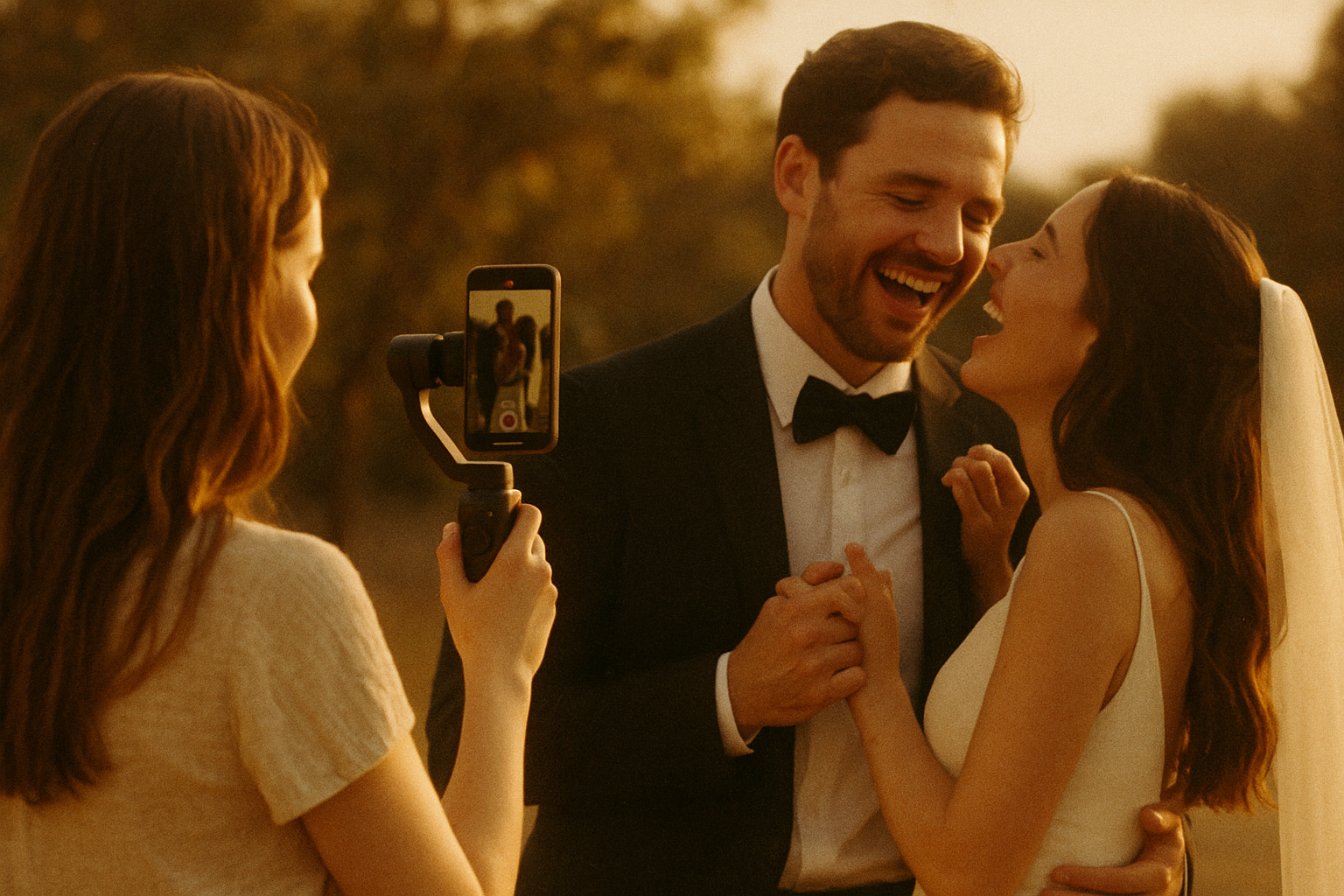
Something shifted. Quietly at first, then all at once. Couples who used to spend hours researching photographers and videographers started asking a completely different question: who is going to make my content? The wedding content creator trend 2026 is not a niche curiosity anymore. It is reshaping how couples think about documentation, memory, and what a wedding is even supposed to produce. And if you haven't heard about it yet, you're about to understand why everyone else has.
The Dirty Secret About Traditional Wedding Video
Most couples get their wedding video back four to twelve weeks after the day. Some wait longer. They open a beautifully edited film, watch it once or twice, share it to a few people, and then it quietly disappears into a folder on Google Drive that gets opened maybe once a year. The video is stunning. The editing is gorgeous. And somehow, the moment has already passed.
This is the quiet frustration that very few vendors talk about openly. Traditional wedding videography was designed for a different era — one where a polished, cinematic film delivered weeks later was the gold standard. That standard made sense before social media changed the pace of everything. Before couples started planning their weddings with one eye on the content they'd share and one eye on the actual day. Before Instagram Stories, TikTok recaps, and the very real emotional experience of watching your own wedding unfold in real time through a screen.
The couples getting married in 2026 are not the same couples who got married in 2016. Their relationship with content, memory, and immediacy is fundamentally different. And the wedding industry is catching up — slowly, in some corners, and rapidly in others.
Why Traditional Options Have Left Couples Feeling Stuck
The standard playbook for wedding documentation has always looked the same. Book a photographer. Book a videographer. Maybe splurge on a photo booth. Wait weeks or months for your deliverables. Post a few highlights when they arrive and hope the algorithm still cares by then.
The problem is not that photographers and videographers do bad work. Most of them do extraordinary work. The problem is that the format was never built for the way couples actually want to experience and share their wedding in 2026. A cinematic film delivered six weeks later is a beautiful artifact. But it does nothing for the friend who was watching your Instagram Stories during the reception hoping to see a clip of your first dance. It does nothing for the morning-after feeling of wanting to relive what just happened. It does nothing for the couple who wants their wedding to feel alive and present, not archived.
Some couples tried to solve this themselves. They asked bridesmaids to capture vertical video on their phones. They handed a cousin an iPhone and a ring light. They hoped guests would post enough that the hashtag would paint a picture. And those solutions mostly produced a chaotic mess of blurry toasts, missed moments, and content that didn't look anything like the wedding they had actually planned.
Others leaned into the idea that social media didn't matter on the wedding day. That the day was sacred and unplugged and the film would come when it came. And then they watched friends post gorgeous same-day Reels and felt something they weren't expecting: a little bit of regret. If you've ever felt that, you're not alone — and some couples talk about it more openly than you'd think.
What Is a Wedding Content Creator, Really?
A wedding content creator is someone hired specifically to capture your wedding day in vertical, social-ready format — the kind of footage that looks like it belongs on Instagram or TikTok rather than on a cinema screen. They shoot on phones, mirrorless cameras, or a combination of both. They understand aspect ratios, platform aesthetics, and the difference between content that stops a scroll and content that gets swiped past in half a second.
Crucially, they deliver fast. Sometimes same-day. Sometimes within 24 hours. Sometimes within a week. The whole point is that the content arrives while the moment still has emotional charge — while your guests still remember the night, while you are still riding the high, while the hashtag still has life in it.
This is a genuinely different role from a videographer or photographer. It is not a replacement for either. It is an addition — a third layer of documentation built specifically for the platform-native way couples experience their lives. Understanding what they actually do makes it much easier to see why so many couples are booking one alongside their traditional vendors.
Why Is the Wedding Content Creator Trend So Big in 2026?
Several things converged at once to make 2026 the year this trend broke through from early adopter territory into the mainstream.
First, the couples getting married now grew up creating content. They are not learning how to think about aesthetics, angles, and platforms — they already know. What they want is someone who can do it at a professional level so they don't have to worry about it on their wedding day. The demand was always there. The supply just needed to catch up.
Second, the social proof loop accelerated. As more couples posted stunning same-day Reels and morning-after recaps, more couples started asking how they did it. The answer, almost every time, was a dedicated content creator. Visibility breeds demand, and in 2026, the visibility is impossible to ignore. Social media is actively changing what couples book, and the data is not subtle about it.
Third, the emotional case became undeniable. Couples who booked content creators started talking about the experience — not just the output, but the feeling of watching their own wedding recapped the morning after. That emotional immediacy, that ability to relive the day before the day has even fully settled, turned out to be something people deeply craved without knowing they were craving it. It's the same reason wedding videos hit so hard emotionally — fast delivery just makes that hit arrive before the dust settles.
Fourth, pricing became accessible. Early content creator bookings felt like a premium luxury add-on. As more creators entered the market and packages became more defined, the cost started to feel reasonable relative to the value — especially compared to waiting two months for a film that most people watch once.
What the Couples Actually Say
The testimonials from couples who booked content creators share a common thread. It is rarely about the quality of the footage, though the footage is almost always described as better than expected. The thing couples talk about most is timing. Getting a recap video the morning after their wedding. Watching it over coffee while still in the hotel. Sharing it before they even left for their honeymoon. Feeling like they actually got to experience their own wedding twice — once while it was happening, and again the next morning through the lens of someone who was paying attention to all the moments they were too present to notice.
That is not something a traditional video delivered six weeks later can replicate. The emotional window is different. The experience of watching it is different. And for many couples, it turned out to be the deliverable they valued most — even when they had booked photographers and videographers alongside it.
How to Think About Adding a Content Creator to Your Day
If you are planning a wedding in 2026 and this is landing, here is how to think about it clearly. A content creator is not a replacement for your photographer. Your photographer captures the still images that will live in frames on your walls and in albums on your coffee table. A content creator captures the motion, the energy, and the feeling of the day in a format built for the screen you actually use every day.
It is also not a replacement for your videographer, if you have one. A cinematic film is a different thing entirely — a slow, intentional, scored piece of work that you will watch on anniversaries and show your children someday. A content creator delivers the immediacy. The two formats serve completely different emotional purposes and different timelines.
What you should ask when evaluating a content creator is simple. How fast do they deliver? What does the output actually look like — is it vertical, is it social-native, does it feel authentic or does it feel staged? Do they understand your aesthetic and your platform? And do they have a track record of making couples feel like the day was captured the way it actually felt, not just the way it looked?
The wedding content creator trend 2026 is not about chasing something shiny. It is about recognizing that the way we experience and share memory has changed, and that the wedding industry has a new role that didn't exist five years ago — one that fills a gap traditional vendors were never designed to fill.
Ready to See If This Is Right for Your Wedding?
If you're curious what this actually looks like in practice — the footage, the turnaround, the experience of having someone on your day whose only job is to capture it the way your phone never could — we'd love to talk. Check Availability and let's find out if we're a good fit for your date.
Frequently Asked Questions
What exactly does a wedding content creator do differently than a videographer?
A wedding content creator shoots specifically for social media platforms — vertical format, fast delivery, designed to be shared on Instagram and TikTok rather than screened as a cinematic film. A videographer creates a longer, edited, scored production that typically takes weeks to deliver. Both serve a purpose, but they fill completely different emotional and practical roles on your wedding day.
Is the wedding content creator trend in 2026 just for social-media-obsessed couples?
Not at all. The wedding content creator trend 2026 has grown because the fast-turnaround content fills an emotional gap that even non-social couples feel — the desire to relive the day while it still feels immediate. Plenty of couples book a content creator who rarely posts online, simply because they want to see a recap the morning after while the feeling is still fresh.
How soon after the wedding do content creators typically deliver footage?
It varies by creator, but the best ones deliver within 24 to 72 hours — some even same-day. This immediacy is the core value proposition. The sooner you receive your footage, the more emotional charge it carries and the more relevant it is to share with guests who were there.
Do I need a wedding content creator if I already booked a photographer and videographer?
If you care about having social-ready content delivered quickly, then yes — because neither a photographer nor a videographer is set up to deliver that. A photographer gives you stills. A videographer gives you a film weeks later. A content creator gives you shareable video content while the day is still alive in everyone's memory.
How do I know if a wedding content creator is actually good?
Ask to see their actual deliverables — not their highlight reel, but the kind of footage couples actually received. Look at turnaround time, aesthetic consistency, and whether their work feels authentic or over-produced. Reading real couple reviews and understanding what the experience was like from booking through delivery will tell you more than a portfolio alone.
Is the wedding content creator trend going to keep growing or is it a passing phase?
All signs point to continued growth. The couples getting married in the next several years are even more platform-native than those getting married today, and the emotional value of fast-turnaround content is not going away. What may evolve is the sophistication of what creators offer — but the role itself is becoming a permanent fixture in the wedding vendor ecosystem.